




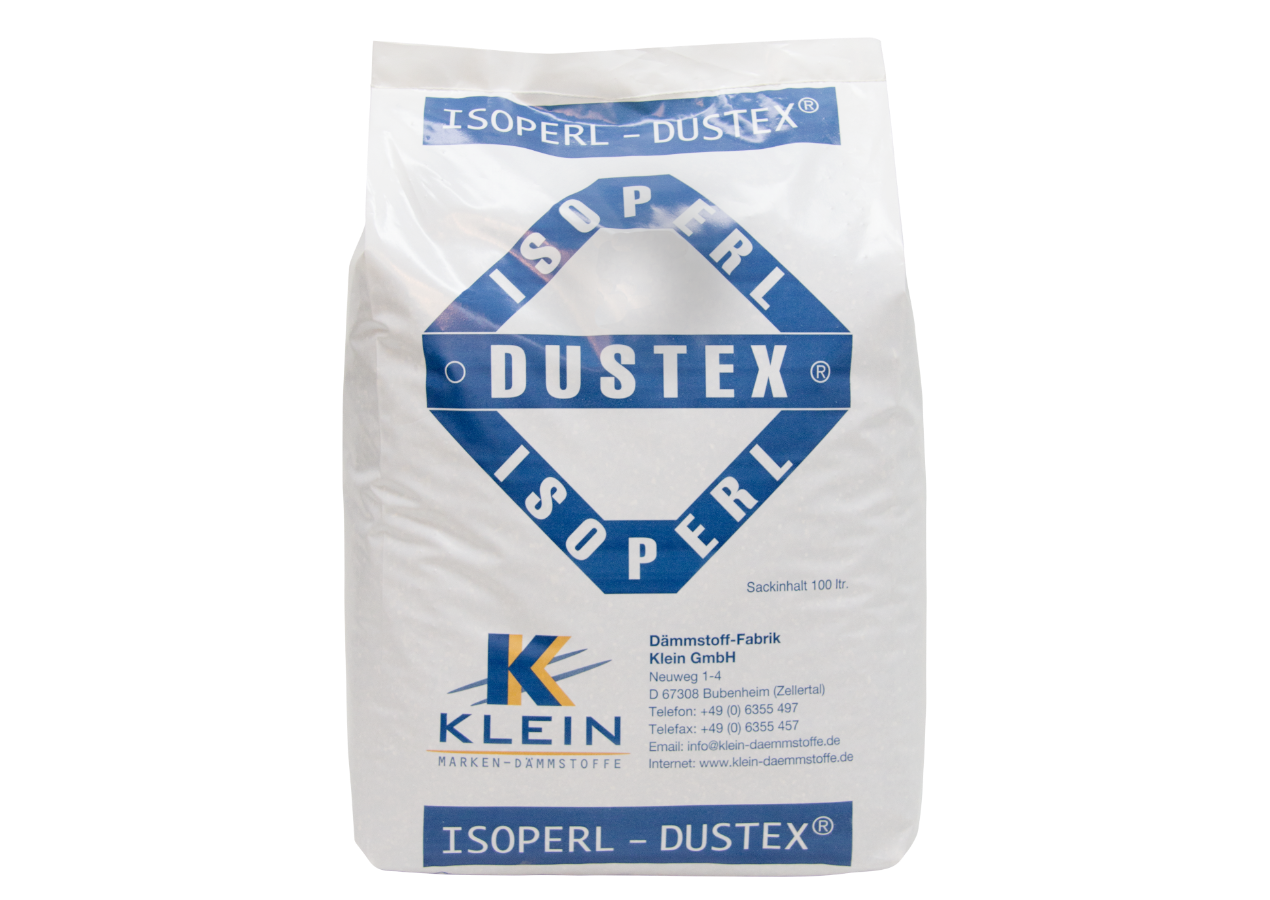
Isoperl®-Dustex®
Processing
Isoperl®-Dustex® is poured directly onto the cleaned bare ceiling and is pulled level and horizontal with a straight edge or using gauges. When introducing more than 40 mm in thickness, a sealing of 20 % must be considered. Isoperl®-Dustex® fillings introduced in this way must also be mechanically sealed. This takes place by placing switch boards on the cover plates or on bitumen corrugated cardboard and sealing it with a hand beater or a light surface shaker.Material requirements
12 litres Isoperl®-Dustex® per m² of surface and per cm of thickness including 20 Vol.-% sealing.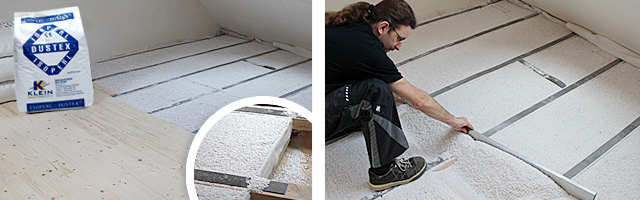
Special processing information
For wet coats, Isoperl®-Dustex® dry filler should be covered with bitumen corrugated cardboard, whereby attention should be paid that the individual tracks overlap by at least 8 cm.
For mastic asphalt screeds, cover plates such as fibre plates with a thickness of 8 - 10 mm are placed on the Isoperl®-Dustex® dry filler under consideration of a clean impact edge with joint displacement. The mastic asphalt is then introduced.
To make sure that the quality of the Isoperl®-Dustex® dry fillers are not adversely affected, switch boards should be used when sealing and the screed masses placed over laid planks.
Installation thickness of Isoperl®-Dustex® and recommended screed thicknesses.
Installation thicknesses of Isoperl®‑Dustex® and the recommended screed thicknesses
| Isoperl®-Dustex® | Minimum thickness of mastic asphalt | Minimum thickness of cement coat |
|---|---|---|
| up to 30 mm | 30 mm | 35 mm |
| above 40 mm incl. seal | 25 - 30 mm | 40 - 45 mm |
Note
According to the revised standard DIN 18560‑2, various materials are defined, but loose fills are not included. Loose fills are now classified as mechanically bound, which also applies to Isoperl®‑Dustex®.
The specified compressive strengths for leveling layers do not apply to mechanically bound fills.
Failure to meet the required strength values, which is the case with Isoperl®‑Dustex®, results in the screed nominal thicknesses specified in Table 1 of the DIN standard no longer being applicable. The screed construction therefore no longer complies with DIN 18560‑2 and is considered a special construction, which must be agreed upon accordingly with the contractor.
Typical chemical analysis
| SiO2 | 74,84% |
|---|---|
| CaO1 | 69% |
| Al2O3 | 12,91% |
| MgO | 0,10% |
| TiO2 | 0,19% |
| Na2O | 3,71% |
| Fe2O3 | 1,32% |
| K2O | 4,52% |
Technical data
| Building material | DIN 4102-A1, non-flammable |
|---|---|
| Thermal conductivity - calculated value | λ = 0,050 W/(m•K) DIN 52612-1 or DIN EN 12667 |
| Granulation | 0-6 mm |
| Bulk weight approx. | 82 kg/m³ ±15% nach DIN 4226-3 |
| Strength | 0,01 MN/m² (the planning thickness is the reduced installation thickness corresponding with the seal of 20 Vol.-%.) |
| Compressive stress | ≥40 kPa in accordance with DIN EN 826 |
These statements are based on the current state of our knowledge. They do not constitute a guarantee of the properties of the described product within the meaning of statutory warranty regulations.